THE FOURTH ISSUE - CONSCIOUSNESS, THINKING,
AND MIND
|
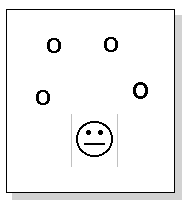
First. We take as given that in the Universe there are numerous things,
and consequently there is space. But assume that none of them moves. There
is an observer (i.e., "face") and many other things but none of
them, including the observer, moves. Because there is not any movement,
there is no time, by definition. The question is: in such a Universe, would
there be any need for consciousness, thinking, or mind in the observer?
|
 |
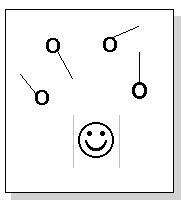
Second. Now, take the condition that there is an observer and that the
things are moving. Because there are things and they are moving, there is
both space and time. The question is: now, is there a need for consciousness,
thinking, or mind in the observer?
|
 |
| Discussion. Without moving things, there would be no need or cause for
consciousness, thinking, or mind. What function could they possibly serve?
Everything would simply be where it is and that is the way it would remain,
forever. There would be no meaning - only being because the relationship
between things would have no function or operation. However, when things
move, then consciousness, thinking, and mind play a role in maneuvering
the observer among the moving objects - approaching, avoiding, trying to
figure out the changing patterns in order to predict and enhance the approaching
and avoiding. Both space and time are modes of thinking (i.e., elements
of consciousness and mind) which describe things that move. Therefore, again,
there is nothing other than things which move. Things which move give rise
to space, time, and to consciousness, thinking, and mind. Descartes rendered
being down to thinking (cogito ego sum); but if thinking is derived from
moving, then I think because I move and, therefore, at a more fundamental
level, one might say "moveo ergo sum". |
|