| Home Page
- - -
Synopsis
- - -
Medical Research Services
- - -
E-mail |
Cancer & Ageing
C.A. Everone
Is cancer a distinct disease? Or is cancer a consequence
of biological ageing? Or is cancer the same as ageing - simply, one of
multiple manifestations (phenotypes) of that degenerative process?
The association of cancer with ageing is not just
an abstract, intellectual interest; it has critical, practical considerations.
Billions of dollars are spend annually for the treatment of cancer as a
particular disease, and after decades of medical "advances",
there has been virtually no progress. Further, comparably large sums of
money (public and private) are allocated to cancer research; and most bio-tech
start-ups reference some type of cancer as one of their therapeutic targets,
because that is where the money is. However, if cancer is caused by ageing
or if it is one manifestation of ageing, then treating it as a specific
disease will never have much merit unless ageing is cured first. Even if
a cure specifically for cancer were to be found, it would be of only marginal
efficacy and have little life-prolonging effect because the ageing process
would continue to proceed or even be accelerated by therapeutic modalities.
I have come to believe that cancer and ageing
are integral; and here is a review of some of the evidence in that regard.
First, the mortality of the general population, which is said to be governed
by the ageing process, is presented and then compared with mortality from
cancer - the comparative survival curves are identical. Indeed, the disease-specific
survival curves for all of the major chronic diseases are identical to
the ageing of the general population. Finally, if cancer were caused by
ageing, then the slowing of ageing should result in a lowering and deferment
of the incidence of cancer - and it does!

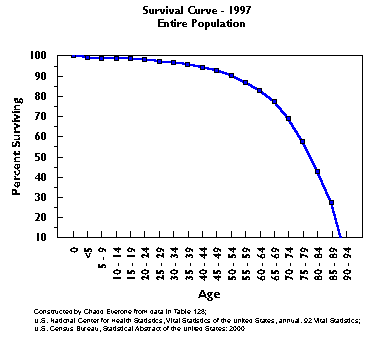
If you chart the survival of a general population
which dies from all causes of mortality (e.g., heart disease, cancer, stroke,
diabetes, homicide, accident, infections, etc.), then you see the following
survival curve.
If you compare the survival curves over the last
100 years, you see a gradual progression toward increased average
life-expectancy (from about 49 to 79) without any real change in the maximum
longevity.
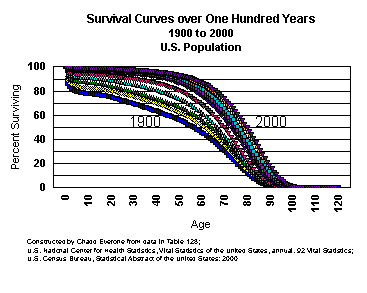
Over the last century, this "squaring"
or optimization of the
survival curve has been caused by an increased standard of living, nutrition,
a host of public health measures and, more recently, medicine. Because
the benefits from this environmental improvement have reached a cul-de-sac,
it is held that the population now experiences ageing and dies mostly from
the chronic diseases. But the issue here is whether the chronic diseases
are separate pathologies and distinct from ageing or if they are different
expression of that general degenerative process.
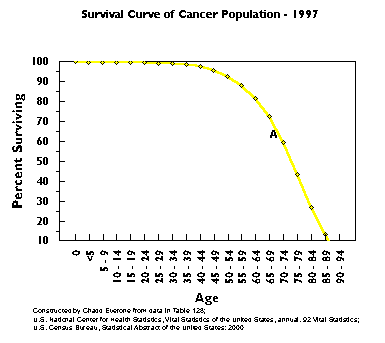
For example, if you were to take everyone who
died from
cancer and treat that group as if it were the entire population (i.e.,
100% of the population died from cancer), then you get the following survival
curve.
If you compare the survival curve of the total
population which dies from all causes of mortality and which ages with
the strictly cancer population, you see the following.
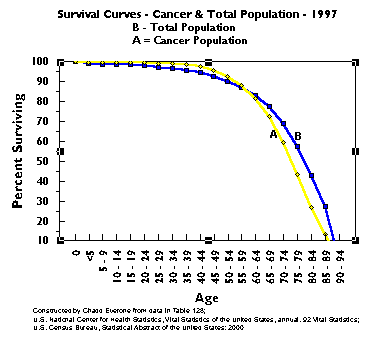
In other words, there is virtually no difference
between the
survival curve of the general mortality population and the cancer population.
Indeed, when we draw survival curves for all of the major chronic diseases
and compare those with the general mortality population, we see that they
are indistinguishable from each other.
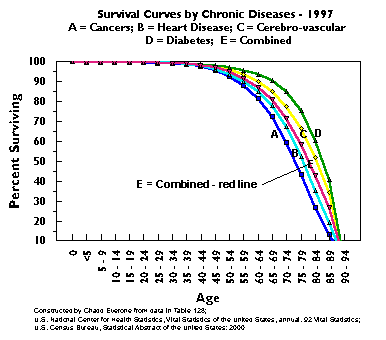
In terms of the survival curve, there is no way
to distinguish
between the chronic diseases and ageing; and it is essentially
pointless to invent treatments or even cures for cancer and the
other chronic diseases unless and until ageing is cured. As a side comment,
the theory of the monoclonal origin of atherosclerotic lesions the atherosclerotic
lesion holds that the "plaque" which causes coronary artery disease
is a type of benign tumor (See MEDLINE
retrieval); and if that is true, then neoplasia, cell mutations, or cancer
constitutes some 60% of all chronic diseases.)
If this hypothesis about cancer being integral
with the ageing process has merit, then techniques which slow ageing should
also lower or defer the incidence of cancer; and in fact that happens.
It is generally accepted that caloric restriction
slows ageing and since the 1940's it has been repeatedly observed and reported
that caloric restriction also lowers and defers the incidence of all chronic
diseases - notably cancers (Tannenbaum A. The dependence of tumor formation
on the composition of the calorie-restricted diet as well as on the degree
of restriction. Cancer Res. 5:616-625, 1945).
"Restriction in food intake imposed continuously throughout
the postweaning life of the rat impressively reduced the incidence, rate
of occurance, and risk of tumors.... Among the histoligically classified
tumors in the chronically underfed rats, the reduction in risk was remarkably
uniform and exceed 90% for the greater number of tumor types." (page
1099 below.)
|